After Damascus launched a military operation against the Syrian Democratic Forces (SDF), the ruling AKP-MHP alliance linked the trajectory of Turkey’s peace process to developments in Syria.
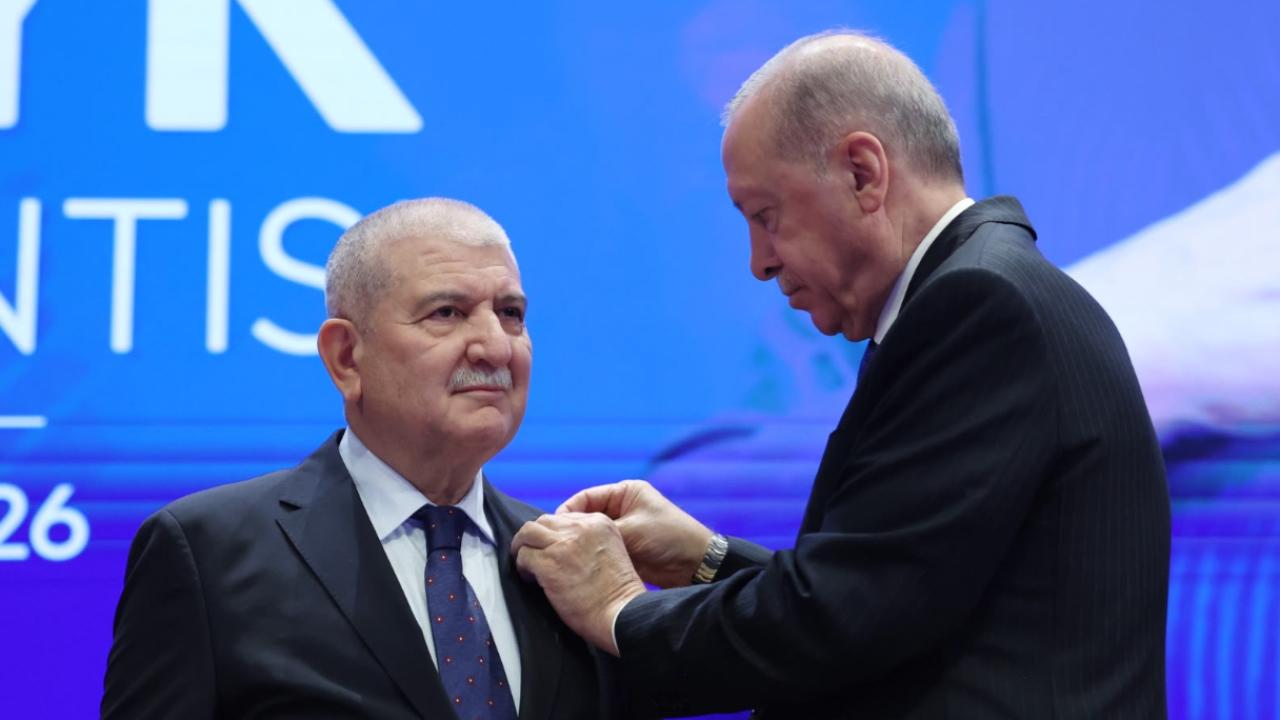
Speaking at the AKP’s parliamentary group meeting, President Recep Tayyip Erdoğan said, “Those not at the table are put on the menu,” as he outlined Turkey’s domestic and regional priorities. He said Turkey is navigating a period of intensified global rivalry while also managing sensitive regional files, including Syria and efforts toward what he described as a “terror-free Turkey.”
According to Erdoğan, stability in Syria and the broader Middle East is directly linked to Turkey’s security. He reiterated that armed structures outside state authority threaten peace and unity and framed Turkey’s Syria policy and Kurdish-related issues as part of a broader peace and security approach, alongside internal reform efforts.
Erdoğan is set to meet the DEM Party’s İmralı delegation for a fourth time at the presidential complex next week. The previous meeting took place on Oct. 30, 2025, amid discussions over whether a parliamentary delegation would travel to İmralı.
MHP: AGREEMENT OR FORCE
Erdoğan’s ally, MHP Chair Devlet Bahçeli, further hardened his rhetoric, saying Syria’s territorial integrity must be secured “either by agreement or by force,” and called on Arab tribes to stand with the Damascus administration.
Speaking at his party’s group meeting, Bahçeli said the delayed integration process in Syria should be completed without further postponement and criticized the SDF and the YPG for advancing what he described as non-negotiable demands that undermine stability.
Bahçeli said the SDF-YPG has established de facto control over a resource-rich area in northeastern Syria and warned that moves he associated with Israel would deepen instability and chaos. He said Syria’s unitary structure and political and territorial integrity must be restored and that Israel’s plans in Syria would fail.
Turkey considers the SDF, whose backbone is the YPG, a terrorist organization. Defense Minister Yaşar Güler said in December 2025 that any integration should take place on an individual basis.
On March 10, Syria’s interim president Ahmed al-Sharaa and SDF General Commander Mazlum Abdi agreed in principle on integrating the SDF into the Syrian army. While negotiations mediated by the United States and France over implementation are ongoing, significant differences remain. Kurdish negotiators favor integrating the SDF as a unified military force, whereas the Syrian government prefers absorbing fighters individually into regular army units.
DEM CALLS FOR ÖCALAN–ABDI TALKS AMID ALEPPO CLASHES
The parliamentary group of the DEM Party called for imprisoned PKK founder Abdullah Öcalan to hold direct talks with Abdi, saying dialogue is needed as fighting continues in northern Syria.
Party spokesperson Ayşegül Doğan said Turkey should play a constructive role in Syria and support dialogue rather than confrontation. She said Öcalan wants to convey his views directly to key regional figures and urged authorities to reopen communication channels.
Doğan said attacks on Kurdish and Syriac neighborhoods in Aleppo must stop immediately, citing civilian casualties and warning that the violence threatens Syria’s stability.
ISIS WARNING AND RESPONSE TO BAHÇELI
DEM Co-Chair Tülay Hatimoğulları said the main threat extending from Syria to Turkey is ISIS, urging the government to approach the issue strategically rather than locally.
She said the antidote to ISIS lies in strengthening what she described as a Peace and Democratic Society Process in Turkey, arguing that democracy is the only way to counter extremism. She framed the peace process as a regional security tool.
Responding to Bahçeli’s remarks on Syria’s integration talks, Hatimoğulları said threatening language would not advance negotiations. She said a smoothly functioning process in Turkey would have positive spillover effects in Syria and that democratic integration is key to regional stability.
She said resolving the Kurdish issue in Turkey through democratic means would help consolidate peace in Syria.
TARGETING FOREIGN AND DEFENSE MINISTRIES
Group Deputy Chair Sezai Temelli said civilians were targeted and described the situation as a crime against humanity, citing at least 10 deaths and around 60 injuries. He urged Turkey, guarantor states and international institutions to act, warning that silence would allow further killings.
Temelli criticized statements by the defense and foreign ministries, saying rhetoric that deepens polarization harms social peace in Syria and fuels disinformation. (Check Foreign Affairs)
Another deputy chair, Gülistan Kılıç Koçyiğit, said neighborhoods were shelled despite a prior agreement that had led to the withdrawal of armed forces. She rejected claims linking local actors to Israel and said disinformation was being used to justify attacks on civilians.
The DEM Party said bullets fired in Kurdish neighborhoods strike peace, democracy and Syria’s future, calling on political parties, civil society and the public to raise their voices.
WHERE IS SHARAA?
Senior PYD figure Salih Müslim said Syria’s interim president Sharaa may have been taken captive either in Turkey or in Damascus, speaking to Kurdish outlet Rûdaw.
Müslim said Sharaa has not appeared in public or made any statements amid reports that he was injured or killed. “I say Ahmed Sharaa has been captured. Either in Turkey or in Damascus,” Müslim said.
He said Sharaa’s silence, despite ongoing violence and the lack of implementation of agreements he signed, raises serious questions. Müslim added that if the claims are untrue, he should appear publicly and address the situation.