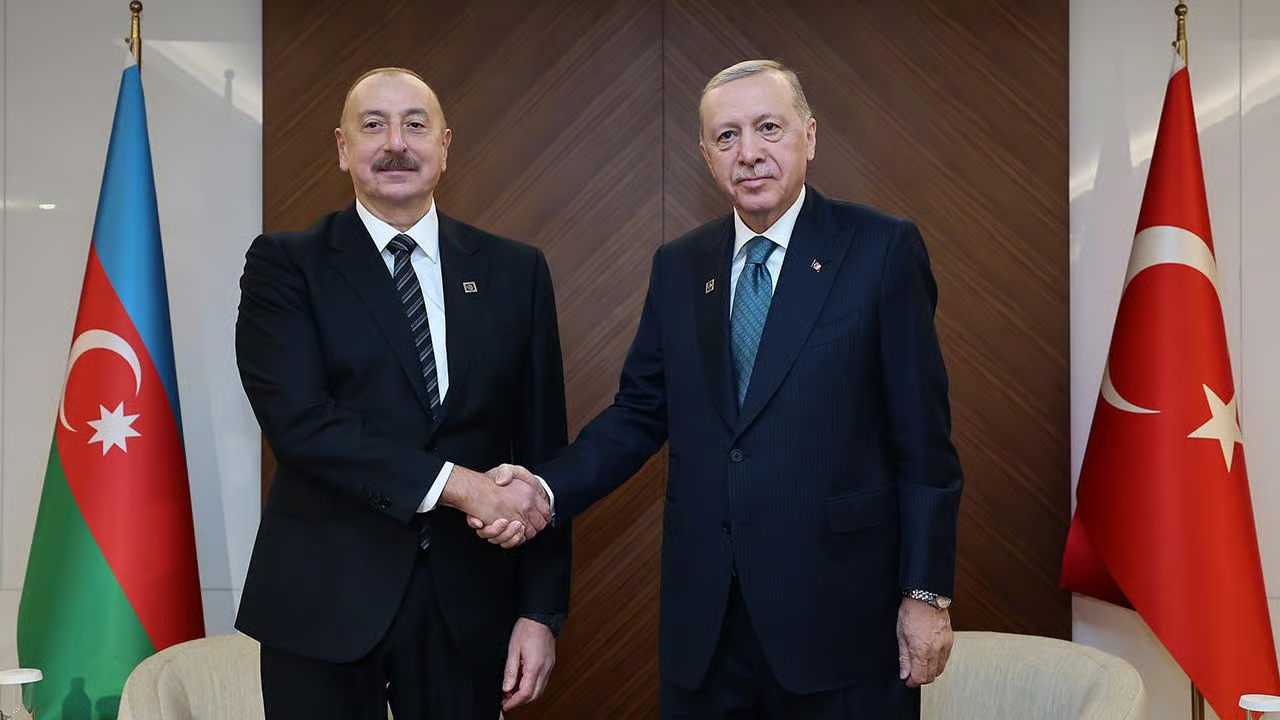
Hungary’s parliamentary elections on April 12 — described as the toughest test of Prime Minister Viktor Orban’s 16-year rule — will be closely watched not only in Europe but also in Turkey by both the AKP and the opposition.
Orban and Turkish President Recep Tayyip Erdoğan have both consolidated their power by eroding democratic rule in their respective countries at the same time as drawing legitimacy from ideas of national will.
The rise of “populism” in politics since 2015, with leaders presenting themselves as “the true representatives of the nation,” is key in analyzing the comparison, according to political scientist Edgar Şar, co-director of the Istanbul Policy Research Institute (IstanPol).
After his first term from 1998 to 2002, Orban returned to power in 2010 and implemented radical changes within just two years, including constitutional amendments and changes to the electoral system. “In this form, it is a design in which another party can hardly win an election. The fair competitive environment that could allow a change of government is eliminated,” Şar told Turkey in Depth.
In Turkey, the 2010 constitutional referendum and the 2017 presidential system referendum also created profound changes in the regime’s character in favor of the ruling party.
Orban distanced himself from the leftist government of 2002–2010, largely remembered for corruption, using the period to instill fear among voters, while Erdoğan similarly frames the politics of the previous era as a “CHP mentality,” using the term in a demeaning way.
“The opposition in Hungary is also remembered for its fragmentation and failures under the old system,” said Şar.
NATIONAL DISCOURSE
Once back in power in 2010, Orban managed the state under an approach he called the “national cooperation system,” while Erdoğan’s discourse, particularly until the critical 2023 elections, highlighted the “New Turkey” narrative.
Both systems show support for families, encouragement of childbirth, and the embedding of foreign policy into domestic political agendas. According to President Erdoğan, external threats are “Western forces seeking to destabilize the country,” while for Orban, “Soros and Brussels” are the primary foreign threats.
There is also a striking similarity between the two countries regarding media ownership, an important benchmark for democratic processes. In Hungary, as in Turkey, major media outlets started to be owned by individuals, companies, or families close to the administration.
Reports from the OSCE Office for Democratic Institutions and Human Rights (ODIHR) on recent elections in both countries also confirm the similarities. In the 2023 elections in Turkey, the report stated that “the incumbent president and ruling parties gained an unfair advantage, particularly through partisan media coverage and use of administrative resources,” while in Hungary’s 2022 elections, “the ruling party gained an unfair advantage by involving state resources in the campaign process and its control over the media.”
OPPOSITIONS WATCHING EACH OTHER
Şar also pointed to the resemblance in the responses of the opposition to authoritarianism in both countries.
In both Hungary and Turkey, the 2019 local elections marked the first electoral victories against long-standing strong governments. In these elections, opposition candidate Gergely Karacsony won the Hungarian capital Budapest, while in Istanbul, CHP candidate Ekrem İmamoğlu ended the AKP’s 25-year rule.
Just as authoritarian leaders around the world take examples from each other, opposition leaders also get inspiration from each other.
Budapest Mayor Karacsony visited İmamoğlu at the Istanbul Municipality building in Saraçhane on August, 2019. “Istanbul is the source of hope for Budapest”, he said.
In Turkey’s 2023 elections, all opposition parties ran together against the AKP under the name “Table of Six,” while in Hungary, in 2022, six opposition parties — coincidentally — ran together against Orban. In both countries, the opposition suffered heavy defeats in these elections.
Another similarity is Russia’s critical support during elections. While Orban secured a price reduction on natural gas from the Kremlin in the 2022 elections, Erdoğan got a postponement of natural gas payments before the 2023 elections.
ORBAN-ERDOĞAN BROMANCE
Erdoğan has been critical of European leaders to boost support at home and so is not very popular among European leaders. The same goes for Orban. The Hungarian leader is one of the very few EU leaders with whom Erdoğan has good rapport.
This relationship has not been overshadowed by Orban’s anti-immigration and even anti-Muslim rhetoric, despite President Erdoğan’s image as a leader of the Islamic world fighting Islamophobia.
However, Erdoğan did not appear in a video prepared by right-wing leaders in support of Orban — including Giorgia Meloni and Matteo Salvini from Italy, Marine Le Pen from France, Alice Weidel from Germany, and Israeli Prime Minister Benjamin Netanyahu.
WILL ORBAN BE DEFEATED?
Şar said that reliable polling companies in the country show that the opposition candidate Péter Magyar is ahead of Orban by 10–15 points.
“There is an expectation in the country that Orban will not hand over power. There is a tendency not to trust the polls. Those who make last-minute decisions or remain undecided will be influential. The opposition is also aware that it will be a long struggle,” said Şar, noting the familiarity with Turkey.