Turkey is watching the protests in Iran with growing concern, warning that U.S. President Donald Trump’s threat of intervention could trigger dangerous regional consequences as Ankara pushes de-escalation through diplomacy with Gulf countries.
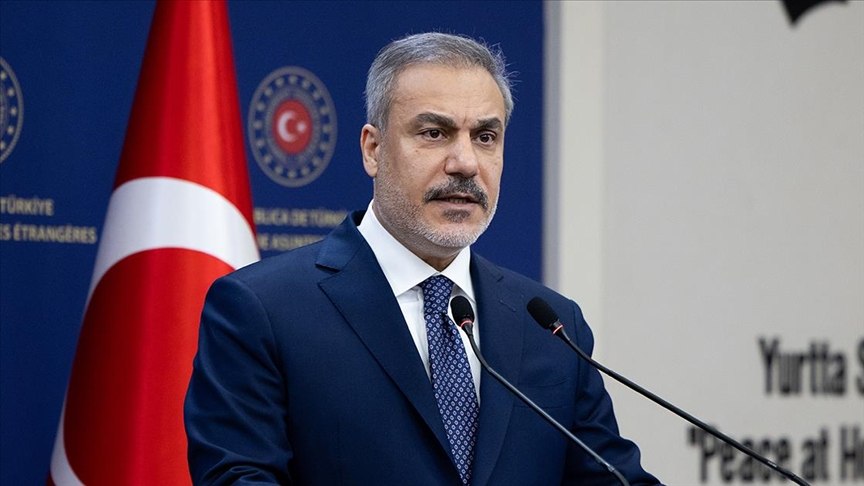
Speaking at his annual press conference, Foreign Minister Hakan Fidan said, Turkey does not approve of military intervention in Iran. “It is also in our interest that Iran resolve its problems with major international actors and avoid instability scenarios that would spread across the entire region.” He stressed that military escalation would create a level of instability that the region cannot bear.
Fidan said the protests in Iran should not be read as an ideological uprising against the regime, but rather as the result of economic hardship exacerbated by international isolation. “Iran has a large population and a dynamic, sophisticated society with a strong desire to participate in life,” he said. “When people are deprived of certain opportunities, these kinds of difficulties emerge.”
Warning against framing economic and social grievances as an ideological revolt, Fidan described the situation as a “gray area,” noting that frustrations over hardship are often misread as a challenge to the regime itself.
Prior to these remarks, Fidan linked the economic hardships driving the protests to U.S. sanctions on Tehran, saying Iran would heed the message of the demonstrations. He pointed to remarks by Iranian President Masoud Pezeshkian along the same lines, adding, “I definitely see that the outcome Israel expects will not materialize.”
Protests continuing in Iran since Dec. 28 have heightened concerns about military escalation in the Middle East after Trump’s remarks, citing the Iranian government’s harsh crackdown on demonstrators. The U.S.-based Human Rights Activists News Agency said the death toll has exceeded 2,000, and the U.S. announced the withdrawal of some personnel from its bases in the region.
However, following talks between Iranian Foreign Minister Abbas Araghchi and U.S. Special Envoy Steve Witkoff, Trump said they had been informed that “executions in Iran have stopped and that there is no plan to execute protesters.” Despite these statements, the possibility of U.S. military intervention has not disappeared.
BUSY DIPLOMATIC TRAFFIC
Amid reports of a high death toll and a possible U.S. intervention, Fidan launched an intensive round of diplomatic contacts.
He first spoke with his Saudi counterpart, Faisal bin Farhan Al Saud. He then met with Iranian Foreign Minister Araghchi, followed by a meeting in Ankara with U.S. Ambassador Tom Barrack.
On Jan. 14, Fidan traveled to the United Arab Emirates, and shortly before his departure, he spoke by phone with Araghchi, marking their second conversation within 24 hours.
Later the same day, media reports said Israeli Foreign Minister Gideon Saar was also in Abu Dhabi.
The U.S. on Jan. 13 urged its citizens to leave Iran via Armenia and Turkey. Reuters reported that a Tehran official said Iran had threatened to attack U.S. bases in regional countries, including Turkey, in the event of a U.S. strike. The Wall Street Journal reported that Gulf countries were working to dissuade Washington from carrying out an attack.
Turkey had also taken a similar position during the 12-day Israel-Iran war last June, citing concerns that it could become a target of Iranian retaliation due to the NATO early warning radar stationed in Kürecik. Iran had said at the time that U.S. bases in the region would be targeted if Washington became involved in the war, and later retaliated against a U.S. base in Qatar following an American strike on three nuclear facilities.
Another concern for Turkey was the risk that prolonged instability along its eastern border could trigger a new wave of migration, adding to existing pressures.