
NATO REINFORCES TURKEY'S AIR DEFENSE DESPITE IRAN-U.S. CEASEFIRE
NATO has further reinforced the air defense it provides for Turkey, despite the agreement between the US and Iran to end the war.
Analysis
Smart, independent reporting on Turkey's politics, economy and foreign affairs.
NATO has further reinforced the air defense it provides for Turkey, despite the agreement between the US and Iran to end the war.
The intended target of the ballistic missile launched from Iran and intercepted on Turkish airspace on March 4 remains disputed. While Turkey said the missile was heading toward the eastern Mediterranean, NATO said the target was Turkey, and U.S. officials pointed to the location, Incirlik Air Base. Iran, however, denied that Turkey was the intended target.
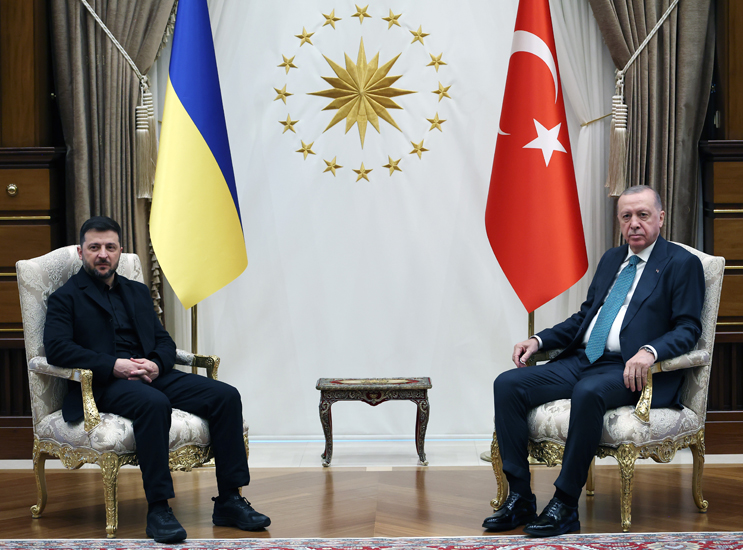
Ukrainian President Volodymyr Zelenskyy made a surprise day-long visit to Ankara on Nov. 19, at a time when press reports revealed the U.S. and Russia had prepared a new framework peace plan.
CHP Chair Özgür Özel said that rare earth elements in Turkey should not be sold to the U.S.
Turkish President Recep Tayyip Erdoğan voiced support for U.S. President Donald Trump’s Gaza peace plan without addressing its specifics, even as pro-government media criticized the proposal and the main opposition party expressed conditional backing.
There is a way of establishing a working relationship with U.S. President Donald Trump. First you have to make sure you see him as a smart, respectable world leader. That’s the easy part. Then you have to lure him with trade deals, making sure he is the winning side. Therefore, it comes as no surprise when Turkey unilaterally dropped its retaliatory tariffs on U.S. products on Sept. 22, a few days before the scheduled meeting between President Recep Tayyip Erdoğan and U.S. President Donald Trump at the White House. Buzzwords are important for Trump, and tariff is one of them. The tariffs, which covered products including passenger cars, fruit, rice, tobacco, alcoholic beverages, solid fuels, and chemical products, were introduced in 2018 in response to U.S. tariffs on steel and aluminum imports enacted during Trump's first term in office.
At a time when the U.S. is mediating talks between Israel and Syria in London, the head of Turkish Intelligence İbrahim Kalın met with President Ahmed al‑Sharaa in the Syrian capital, Damascus.
The world’s spotlights were turned to Istanbul last week as Russian and Ukrainian delegations met for the first time after three years. The prospect of a potential meeting between the Russian and U.S. leaders in Turkey led to praise for Turkish President Recep Tayyip Erdoğan by some international media outlets.
The US Ambassador to Turkey and Special Envoy for Syria Tom Barrack is under attack in Turkey and the United States for saying Middle East countries require “strong leadership.”
Turkey shows signs of renewing its ties with its NATO alliance partners amid the ongoing Iran crisis. The renewal of vows follows a tempestuous period in its relations not only with the U.S. but also with NATO following the acquisition of the S-400 air defense system from Russia. Particularly over the past 20 years, facing U.S. CAATSA sanctions and Europe’s covert arms embargoes in the fight against the PKK, Turkey’s government and opposition have both questioned the value of NATO membership.
Turkey once again requested the extradition of hundreds of people from the Netherlands, as the Dutch Justice and Security Minister David van Weel expressed hope that Turkey could play a mediating role in the war between the U.S., Israel, and Iran.
As Turkey steps up mediation efforts to halt the war against Iran, it is seeking to avoid holding the United States directly responsible.