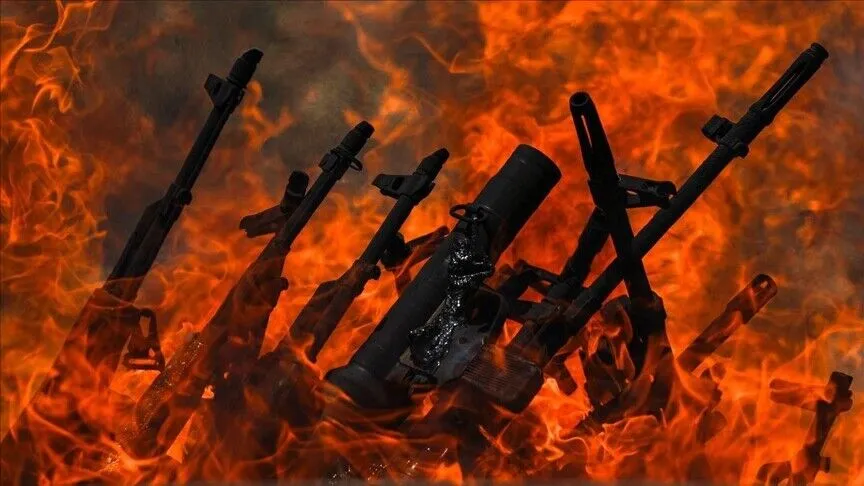
OCTOBER HOPES FADE AS MGK STAYS SILENT ON PKK DISARMAMENT
Expectations that the Framework Law on the Terror-Free Turkey process would take effect in October have shifted to December.
Analysis
Smart, independent reporting on Turkey's politics, economy and foreign affairs.
Expectations that the Framework Law on the Terror-Free Turkey process would take effect in October have shifted to December.

With the framework law in force and mechanisms in place to allow the return of PKK militants, the peace process has moved into a new phase — not without controversy.
Following the framework law's acceptance by a high vote of 467 in parliament — legislation expected to end a half-century-long conflict in relation to the Kurdish issue— now eyes are on the next steps the government will take.
A reference to Israel Prime Minister Benjamin Netanyahu’s remarks was enough to increase the tension between the AKP and DEM soon after the two’s cooperation on the framework law.
Debate is underway over how the political balance will shift after the “Framework Law,” which establishes the legal basis for the PKK’s disarmament process, passed the 600-seat parliament with a record 467 votes. The overwhelming support for the law is expected to whet the government’s long-standing appetite for a “new constitution.” But is that possible before the general election, now 20 months away if held on schedule?
The İYİ Party was the only party to vote as a bloc against the framework law on the Kurdish peace process. Its instincts on the nationalist right are already well known. But before turning to the party, it is worth dwelling for a moment on its chair. Let us begin with his name: Müsavat.
Parliament breaks for recess, framework law tucked in its wake, Yeni Party supporters divided over the vote it made.
Turkey's nationalist opposition parties escalated their criticism of the framework law that is expected to regulate the return of PKK members, rebuking the government for showing the draft to jailed PKK leader Abdullah Öcalan before parliament or the public.
The “framework law” that will provide the legal basis for the PKK’s disarmament process appears set to be enacted after nearly five months of waiting. Öcalan’s view that “even if it is incomplete and inadequate, a step needs to be taken” proved instrumental in overcoming the disputes surrounding the law. In a sense, it was Öcalan who untied the knot.
The DEM Party is intensifying pressure on the AKP/MHP ruling alliance to pass the framework law underpinning Turkey's Kurdish peace process before parliament enters for its summer recess — even as the party struggles to extract details of the draft from the AKP. The push has produced a flurry of contacts. İmralı Delegation members Pervin Buldan and Mithat Sancar, together with Faik Özgür Erol, met AKP Deputy Chair Efkan Ala and AKP Group Chair Abdullah Güler on July 15, and MHP Chair Devlet Bahçeli at his office in parliament the following day. Asked about the talks, Buldan declined to elaborate: 'We will not give information on the content.'
The peace process, dubbed the Terror-Free Turkey, now awaits the 'framework law,' expected to be submitted before parliament goes into its summer recess. There appears to be no consensus, however, on the bill's exact timing, scope and the conditions on the ground. While the process remains in the waiting room, the Interior Ministry took a concrete step, lifting thousands of search points and checkpoints in the terror-affected region. The pro-Kurdish DEM Party, through all its spokespeople, is asking 'what the law is waiting for.' But reading between the lines of AKP and DEM Party statements reveals disagreements at the draft stage.
President Recep Tayyip Erdoğan has signaled that the long-awaited framework bill aimed at ending the PKK's decades-long armed struggle will be submitted to parliament soon.