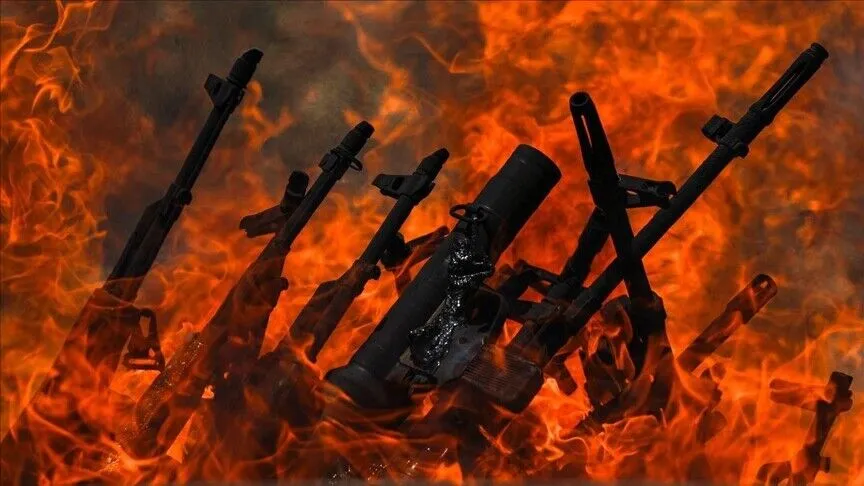
OCTOBER HOPES FADE AS MGK STAYS SILENT ON PKK DISARMAMENT
Expectations that the Framework Law on the Terror-Free Turkey process would take effect in October have shifted to December.
Analysis
Smart, independent reporting on Turkey's politics, economy and foreign affairs.
Expectations that the Framework Law on the Terror-Free Turkey process would take effect in October have shifted to December.

Turkey's oldest and main opposition party, the CHP, is now effectively divided in two after a court annulled the party's November 2023 congress and reinstated former chair Kemal Kılıçdaroğlu in place of Özgür Özel. The split became more visible when both camps held rallies simultaneously at 2 p.m. on May 30. Kılıçdaroğlu returned to party headquarters to chants of 'Kılıçdaroğlu, the people's hope' — a stark reversal from just days earlier, when another crowd had branded him a 'traitor' and 'the AKP's hope' on May 24, reacting to the court-ordered change in the party leadership carried out with police support. The first head-to-head show of strength between the two camps laid bare a simple reality: Özel commands greater grassroots support, but Kılıçdaroğlu holds the formal authority to run the party.
President Recep Tayyip Erdoğan has fueled hope for progress in the Kurdish process but his stance doesn’t amount to real movement, according to the DEM Party. Soon after dismissing claims of a deadlock in the "Terror-Free Turkey" process as "noise" at the April 23 reception, Erdoğan reiterated that the process is advancing as intended and urged all actors to act responsibly during a turbulent regional period.
Following the consensus between Syria’s interim government and the Syrian Democratic Forces (SDF), momentum has returned to Turkey’s long-running efforts to end the decades-long armed conflict and address the Kurdish question through political and legal channels. This renewed dynamic has also pushed the “right to hope” for PKK leader Abdullah Öcalan back to the center of the political agenda.
The parliamentary commission formed to pave the way for a new Kurdish peace process remains stuck over whether its members should visit jailed PKK leader Abdullah Öcalan. A planned session of the commission has been postponed once again, even as hopes rise for the release of imprisoned Kurdish politician Selahattin Demirtaş following a third ruling by the European Court of Human Rights (ECHR).
An Ankara court on Sept. 11 overturned the ruling that appointed an interim committee to run the main opposition party’s Istanbul branch. According to the CHP, the decision from the Ankara 3rd Civil Court of First Instance effectively nullified the earlier ruling of the Istanbul 45th Civil Court, in line with CHP’s argument that only an Ankara court can rule since the party’s headquarters are in Ankara. Yet, the decision can be appealed in a higher court.
Hopeful for the disarmament of the PKK after the ceremonial burning of arms, the Turkish government is observing developments on the ground while efforts to establish a commission in the parliament look set to drag into next week. Parliament Speaker Numan Kurtulmuş visited MHP and CHP chairs, but the commission’s structure and name were not finalized. Now, he is expected to meet once again with the parliamentary group deputy chairs. The meeting, initially planned for July 25 is expected to be postponed to July 28 at the earliest. After the framework is set, commission members will be appointed. While the head of Turkish intelligence, İbrahim Kalın, toured all the party groups in the parliament, the media tracked a tempest in a teapot after MHP Chair Devlet Bahçeli confirmed reports that he proposed appointing two vice presidents—one Kurdish and one Alevi.
Turkey once again requested the extradition of hundreds of people from the Netherlands, as the Dutch Justice and Security Minister David van Weel expressed hope that Turkey could play a mediating role in the war between the U.S., Israel, and Iran.
The “process report” that charts the roadmap for Parliament toward solving the Kurdish question has been finalized. The document did not push the limits of the AKP and MHP too far; it received a cautious “hopeful” endorsement from the CHP on the grounds that accepted democratic demands “must not remain mere words on paper”; the DEM Party deemed it “better than nothing” despite its shortcomings; and the Yeni Yol group welcomed with a familiar “not enough, but yes.”
MHP Chair Devlet Bahçeli raised the bar this week in the Kurdish peace process he launched in October 2024. He proposed the “right to hope” for Abdullah Öcalan. What do we mean by the right to hope?
The “new peace process” began with convention-shattering moves such as granting the “right to hope” to PKK leader Abdullah Öcalan and, after 15 months, is now not even back where it started. In fact, it has probably moved backward.
The election of Tufan Erhürman as president of Northern Cyprus rekindled hopes for renewed negotiations with the Greek Cypriots.Erhürman’s opening statements — stressing democratic tolerance, representation and the need to reopen talks under UN auspices with political equality as his “red line” — set a constructive tone: “There are no losers in this election. The Turkish Cypriot people won, our children won, our brotherhood won.” Yet those words of unity sit alongside firm warnings: political equality cannot be treated as a bargaining chip, and any new process must have meaningful limits and commitments from the outset.