
TURKEY AGREES ON PHASED MILITARY WITHDRAWAL FROM IRAQ
Turkey has agreed with Baghdad on the gradual withdrawal of its troops from northern Iraq, and a similar step may soon be taken in Syria as well.
Analysis
Smart, independent reporting on Turkey's politics, economy and foreign affairs.
Turkey has agreed with Baghdad on the gradual withdrawal of its troops from northern Iraq, and a similar step may soon be taken in Syria as well.
The pause breaks in a week, as pauses always do: Washington and Riyadh strike Iraq anew.

A live signing ceremony crowning Iraqi Prime Minister Ali Al Zaidi's visit to Ankara was disrupted when a Development Road agreement went unsigned, prompting President Recep Tayyip Erdoğan to intervene on camera and Al Zaidi to confront his own transport minister.
Turkey made simultaneous overtures to Iraq and Syria at a critical moment for the peace process, as the government prepares to submit the bill to parliament before the summer recess. National Intelligence Organization (MİT) chief İbrahim Kalın completed a three-day tour of Iraq while Interior Minister Mustafa Çiftçi held security talks in Damascus.
Tom Barrack, now appointed as special envoy to Iraq in addition to his ambassadorial role in Turkey and special envoy role in Syria, described Iraq, Syria, and Turkey as 'the strategic fulcrum upon which any enduring Middle East stability must pivot,' calling for a single, consistent point of American contact across the three nations.
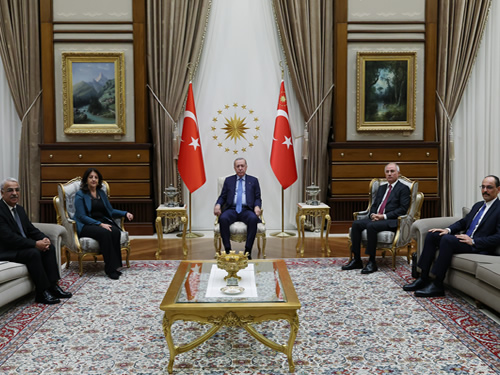
President Recep Tayyip Erdoğan hosted the DEM Party’s İmralı delegation, as the parliamentary commission listened to Foreign Minister Hakan Fidan and Justice Minister Yılmaz Tunç for the first time since the PKK announced that all its forces in Turkey had begun withdrawing to northern Iraq.
All eyes are on Sulaymaniyah in northern Iraq, where the first group of PKK members is set to disarm on July 11 — the organization’s first act of disarmament since its founding nearly 50 years ago. This symbolic ceremony follows the PKK’s May 12 announcement of its decision to disband. Depending on when subscribers opt to read this issue, the footage may have already surfaced.
The term of the presidential motion authorizing the deployment of Turkish Armed Forces in Iraq and Syria to combat terrorist organizations and the acceptance of foreign troops in Turkey has been extended for another three years.
The Defense Ministry has completed its investigation into the deaths of 12 soldiers who were exposed to methane gas in a cave in northern Iraq during a search operation on July 6, concluding that there was no evidence of negligence or misconduct on the part of the commanders involved in the incident.
Twelve Turkish soldiers died from gas exposure in a PKK-used cave in northern Iraq on July 6, and two more from excessive fluid loss in Hatay on July 25, but key questions about both incidents remain unanswered.
After a decision to terminate the 1973 crude oil pipeline agreement with Iraq as of July 27, 2026, Turkey started negotiations with the Iraqi central government for a more comprehensive agreement on the transportation of Iraqi oil. The move is not a withdrawal from the partnership but a strategic reset. Under the 1973 agreement and its supplementary protocols, either party must notify the other at least one year before expiry if it intends to terminate the deal. If no such notice is given, the contract automatically renews for five years. Turkey has now officially informed Iraq of its intent to withdraw, preventing automatic renewal and opening space for renegotiation.
The Defense Ministry announced that 12 soldiers died on July 6 from methane gas during a search of a cave previously used as a hospital by the PKK in northern Iraq. Opposition parties called for a parliamentary commission to investigate whether the necessary precautions, including the use of gas masks and detectors, were taken when the soldiers entered the cave, but this proposal was rejected by AKP and MHP votes.