
MORFOZ ON STAGE
Turkish defense industry companies continued testing its newly developed products, such as Morfoz and Gökalp.
Analysis
Smart, independent reporting on Turkey's politics, economy and foreign affairs.
Turkish defense industry companies continued testing its newly developed products, such as Morfoz and Gökalp.

Turkish defense industry companies demonstrated their high-precision strike capabilities through various integrated systems.
The NATO summit in Ankara provided an important opportunity for Turkey to showcase the progress of its defense industry. By now, few can have missed the fact that Turkey has become the world's 11th-largest arms exporter.
Companies showcased $70 billion in products to state leaders at the defense industry forum that took place alongside the NATO Summit in Ankara.
The Turkish Armed Forces has been testing joint operations capabilities after a rapid increase in the number of national defense industry products in its inventory, primarily electronic warfare and air defense systems, warships, and unmanned aerial vehicles. Baykar's AI-powered mini cruise missile Kemankeş-1 continues to undergo firing tests from the strategic-class Bayraktar Akıncı UCAV. “The Kemankeş smart munitions integration and testing activities carried out with the Akıncı strategic UAV platform, capable of flying at an altitude of 40,000 feet, provide serious indications of Turkey's hyper warfare capacity development,” Dr. Can Kasapoğlu, senior researcher at the Hudson Institute, said.
The specifications announced far exceed any product developed by the Turkish defense industry to date.
Seeking to capitalize on the rift in the NATO alliance between the U.S. and the EU, Ankara is seeking common ground with Europe through cooperation on military issues and the defense industry.
Head of the Defense Industries Presidency (SSB) Haluk Görgün refrained from announcing a total export target for the defense industry, instead outlining project-based goals for 2026.
As Turkey prepares to purchase 12 second-hand Eurofighter Typhoon fighter jets from Qatar, a series of defense industry cooperation agreements were signed between the two countries, further deepening bilateral relations.
Under the agreement signed between Turkey and the U.K., the £5.4 billion payment to the Eurofighter consortium for 20 Typhoon fighter jets was not included in either the Defense Ministry’s budget or the Defense Industry Presidency's (SSB) budget. The Defense Industry Support Fund (SSDF) can be used as a source of funding for this project, but the cost of the Typhoons is approximately double the annual amount transferred to the fund from taxes collected by the state.
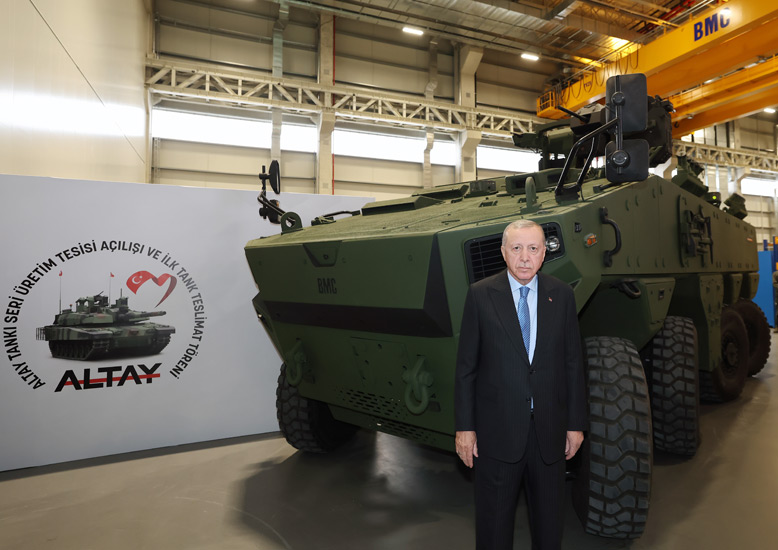
The first Altay tank was delivered to the army on Oct. 28, crowning a three-decade push to develop and produce a domestic main battle tank. The project, launched by a 1996 decision of the Defense Industry Executive Committee, aimed to build an indigenous tank using locally developed technologies. However, the finalized model relies on South Korean-made engines and transmission systems.
The high-speed target drone Şimşek, developed by Turkish Aerospace Industries (TAI), has been transformed into a kamikaze platform, Defense Industry Presidency chief Haluk Görgün announced on Aug. 22.