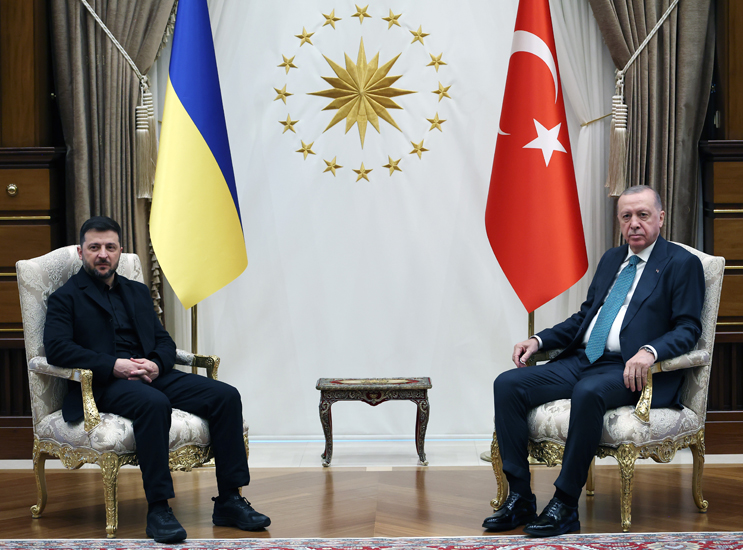
ZELENSKYY VISITS ANKARA, AS A NEW TRUMP PLAN APPEARS
Ukrainian President Volodymyr Zelenskyy made a surprise day-long visit to Ankara on Nov. 19, at a time when press reports revealed the U.S. and Russia had prepared a new framework peace plan.
Analysis
Smart, independent reporting on Turkey's politics, economy and foreign affairs.
Ukrainian President Volodymyr Zelenskyy made a surprise day-long visit to Ankara on Nov. 19, at a time when press reports revealed the U.S. and Russia had prepared a new framework peace plan.

The parliamentary commission formed to pave the way for a new Kurdish peace process remains stuck over whether its members should visit jailed PKK leader Abdullah Öcalan. A planned session of the commission has been postponed once again, even as hopes rise for the release of imprisoned Kurdish politician Selahattin Demirtaş following a third ruling by the European Court of Human Rights (ECHR).
Turkish President Recep Tayyip Erdoğan voiced support for U.S. President Donald Trump’s Gaza peace plan without addressing its specifics, even as pro-government media criticized the proposal and the main opposition party expressed conditional backing.
With TRIPP, the Trump Route for International Peace and Prosperity, dominating global headlines, it feels only right to turn our gaze to its Turkish near-homonym: trip atmak or trip yapmak. No, this is not another geopolitical acronym. In Turkish slang, trip is a native borrowing of English, stripped of tourist connotations and recast to mean sulky attitude. (Do watch the TikTok video for a full explanation) You can atmak (“throw”) a trip, a sudden sulk, or yapmak (“make”) one, meaning a longer, more orchestrated performance with a few dismissive or harsh words thrown in. Both have elbowed aside the more traditional surat asmak (“to pout”).
Hopeful for the disarmament of the PKK after the ceremonial burning of arms, the Turkish government is observing developments on the ground while efforts to establish a commission in the parliament look set to drag into next week. Parliament Speaker Numan Kurtulmuş visited MHP and CHP chairs, but the commission’s structure and name were not finalized. Now, he is expected to meet once again with the parliamentary group deputy chairs. The meeting, initially planned for July 25 is expected to be postponed to July 28 at the earliest. After the framework is set, commission members will be appointed. While the head of Turkish intelligence, İbrahim Kalın, toured all the party groups in the parliament, the media tracked a tempest in a teapot after MHP Chair Devlet Bahçeli confirmed reports that he proposed appointing two vice presidents—one Kurdish and one Alevi.
Amid renewed calls for unity during the ongoing peace efforts with the PKK, and following President Recep Tayyip Erdoğan’s recent emphasis on solidarity among Turks, Kurds, and Arabs, MHP Chair Devlet Bahçeli has confirmed reports that he proposed appointing two vice presidents—one Kurdish and one Alevi—in a closed-door party meeting.
In a symbolic act seen by many as the first step toward a “terror-free Turkey,” a 30-member group affiliated with the PKK ceremonially burned their weapons and gear in front of a fire sacred to Kurds, initiating a process expected to proceed through mutual steps. In response, Parliament Speaker Numan Kurtulmuş invited political party representatives to a July 18 meeting to discuss forming a parliamentary commission tasked with drafting the legal framework for this new peace initiative.
The pace of the Kurdish peace process, and the model it will follow have now become intertwined with Abdullah Öcalan's lifespan.
Ahead of the AKP’s inaction, MHP Chair Devlet Bahçeli has outlined a detailed institutional framework to advance the peace process, urging all three branches of government to take concrete steps — while President Recep Tayyip Erdoğan declared his government's determination to see it through without giving up caution.
President Recep Tayyip Erdoğan renewed his commitment to the “Terror-Free Turkey” process even as signs emerged of internal division within the government over whether the PKK is disarming and the PKK accused Turkey of stalling.
This week, Yerevan is not a distant capital at the edge of Europe’s map. Armenia has hosted the European Political Community summit at a moment when its political direction, its European ties and the regional peace process are all under scrutiny at once.
The Terror-Free Turkey process, widely dubbed as frozen or stalled, has been revived by President Recep Tayyip Erdoğan’s latest remarks. Erdoğan said the process, now entering its 18th month, has reached a critical juncture requiring much more delicate management: “There is a positive atmosphere. What needs to be done is clear. The process is proceeding as it should.”