
BETTING SCANDAL IN FOOTBALL INVOLVES PLAYERS
The Turkish Football Federation (TFF) has provisionally referred 1,024 footballers to the Professional Football Disciplinary Committee on grounds of betting and has published a list of their names.
Analysis
Smart, independent reporting on Turkey's politics, economy and foreign affairs.
The Turkish Football Federation (TFF) has provisionally referred 1,024 footballers to the Professional Football Disciplinary Committee on grounds of betting and has published a list of their names.
In early November 2025, two gatherings revealed the evolving architecture of Eurasian energy and resource corridors: the “3+1” Energy Ministerial in Athens, bringing together Greece, Cyprus, Israel, and the United States, and the C5+1 Summit in Washington between the United States and the five Central Asian republics—Kazakhstan, Uzbekistan, Turkmenistan, Kyrgyzstan, and Tajikistan.
Selahattin Demirtaş has long been more than a defendant; he is a barometer of how politics manages law, another act in a long-running political drama in Turkey. This is not a scripted series that keeps millions guessing on Thursday nights; it is a real-world production about the country’s future.
In Turkish, the word hakem conjures, for the average football fan, the image of a man with a whistle — revered when he blows it in your favor, reviled when he doesn’t. Yet the word has a far deeper pedigree. Hakem comes from the Arabic ḥakam, meaning “one who judges,” sharing roots with hakim (judge or ruler) and hikmet (wisdom). The referee is, linguistically at least, meant to be a wise arbiter among impassioned players and fans — no small task given the layers of expectation and resentment attached to every call.
You may ask, “Meral Akşener? Where did that come from?” It’s been a year and a half since she bid farewell to both the İYİ Party leadership and active politics. She has remained completely silent since. Yet, in recent days, an unexpected Akşener debate has been simmering—not in the headlines, but in İYİ Party circles. The discussion did not start with her; she has kept her silence. But when Esma Bekar—Akşener’s former chief of staff and perhaps the person closest to her—posted a message, the question suddenly arose: “Is Akşener returning?”
The National Solidarity, Brotherhood and Democracy Commission postponed its meeting scheduled for Nov. 13 for a second time after a Turkish military cargo plane crashed near the Georgia–Azerbaijan border, but the second postponement is now delaying the commission’s roadmap as well.
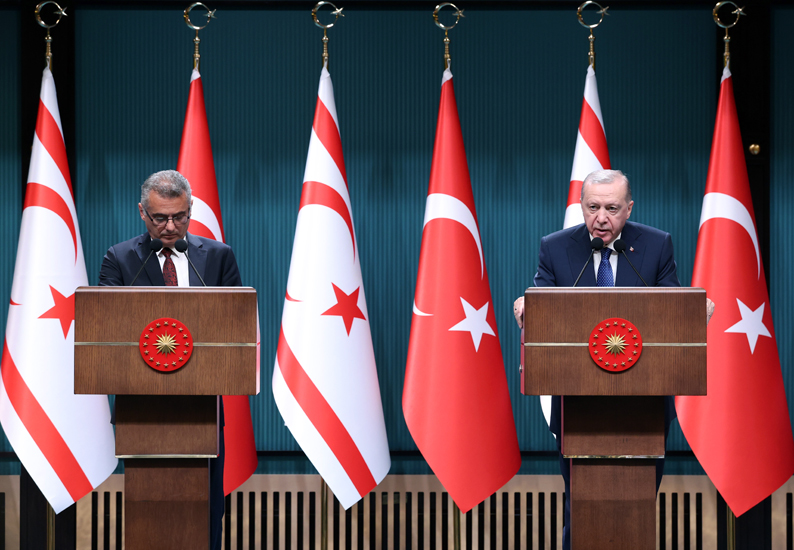
At their first meeting in Ankara, President Recep Tayyip Erdoğan and newly elected Northern Cyprus President Tufan Erhürman restated their long-held positions on the Cyprus issue — this time with a measured but noticeable distance.
In Turkey, çubuklu pijama, or striped pajamas, means much more than bedtime. It’s the uniform of the “baba”: the modest patriarch who comes home, trades his jacket for cotton stripes, and settles in front of the evening news. A garment of thrift and decency, it once stood for the steady comfort of the lower middle class.
Excluding their early courtship phase, the AKP and MHP have now completed seven years of formal partnership. In their partnership, branded the “People’s Alliance,” the two parties have gone through five electoral contests — one referendum, two general elections, and two local elections. Like any relationship, this one has had its ups and downs. Many of the rifts that the public interpreted as “cracks” or “crises” within the alliance were quickly smoothed over through mutual statements. But, the crisis of the past two weeks has been among the deepest since the alliance was formed.
With a trustee taking control and editor-in-chief Merdan Yanardağ under arrest, TELE1’s staff continued to resign en masse as the CHP promised to revive the station through a new platform.
Turkey’s Banking Regulation and Supervision Agency (BDDK) released new data covering the first nine months of 2025, revealing the country’s debt landscape by province. The capital, Ankara, recorded the highest total credit debt, while the central Anatolian province of Karaman had the largest share of citizens unable to repay their loans and facing collection proceedings.

In political terms, the conflict between Armenia and Azerbaijan is over, but in the socio-psychological dimension, it continues, according to the Armenian prime minister. 'When I talk about peace, it seems strange and even alien to many. Peace is an unfamiliar concept for Armenia and Azerbaijan,' Nikol Pashinyan said Nov. 4 at the annual forum of the Orbeli Center, which operates under the Prime Ministry.